
… in game based language teaching (GBLT)
… in digital game based language learning (DGBLL),
… in games in second language teaching and learning (games in L2TL),
… in gameful L2TL,
… etc. etc. etc.
I have seen a LOT of vaporware GBLT MA theses and research papers. People are constantly “reinventing” or “rediscovering” using games in language acquisition. Always taking those same first steps.
“What steps,” you might ask.
There are so many papers that ask and answer these kinds of questions:
- Do games contain useful language? (vocabulary, grammar, functional language)
- What are the differences between game genres?
- Do my students like games?
- What are my students’ perceptions of games being used in the classroom
- What are teachers’ perceptions of games being used in the classroom?
And these questions are “fine.” I definitely started 20+ years ago asking questions like that.
The next questions tend to be:
- What would a lesson plan that uses game X look like?
An example is:
Where in the World of English is Carmen Sandiego? – Carla Meskill, 1990
and that’s from 1990.
1990!
Here’s another lesson plan MA from 2016 that I really do like .. it takes Reinhardt and Thorne’s bridging activities pedagogy and sketches out a lesson plan.
Bridging Activities Cycle: Design and Defense
Kim, J. (2016). Bridging activities cycle: Design and defense. Issues in EFL: Sookmyung Women’s University MA TESOL Journal, 12(2), 56-60.
And that’s from 2016. 25 years of sharing lesson plans. With no end in sight. I’ve set up google scholar alerts for that Meskill paper and keywords that keep the GBLT lesson plans popping into my inbox regularly.
With fewer instances of the lesson plans being taught and shared.
James recently shared another one in the Ludic Language Pedagogy Discord:
Digital Game-Based Language Learning for Vocabulary Development
Chowdhury, Dr. M., Dixon, Dr. L. Q., Kuo, Dr. L.-J., Donaldson, Dr. J. P., Eslami, Dr. Z., Viruru, Dr. R., & Luo, Dr. W. (2024). Digital Game-Based Language Learning for Vocabulary Development. Computers and Education Open, 100160. https://doi.org/10.1016/j.caeo.2024.100160
As a quick rundown of this research:
- 13 students completed 8 50-minute game-building sessions
- They used scratch to make games these topics: water cycle, the lifecycle of frogs, African elephants, and school uniforms
- No details of the games made, at all.
- Results/key findings
- Digital Game-Based Language Learning (DGBLL) facilitates vocabulary development
- DGBLL promotes intrinsic motivation
- DGBLL allows for contextualized language learning
- DGBLL encourages focused tinkering
- Educators should design more generative learning environments
Yep, this is where the research on digital games in language learning is, still, in 2024.
- It was possible to teach vocab.
- It was fun.
OK… so “the field” again and again…
- thinks about / analyzes some games
- collects some opinions/habits from students
- sketches out some lesson plans
But then doesn’t seem to actually…
- teach the lesson
- research the lesson
- share the results of the lesson
And the project becomes “vaporware” and the field remains “vaporware.”
And the thinking and sketching out seem to repeat again and again.

Are they going forwards or backwards? Who can tell?
It’s a hype cycle again and again
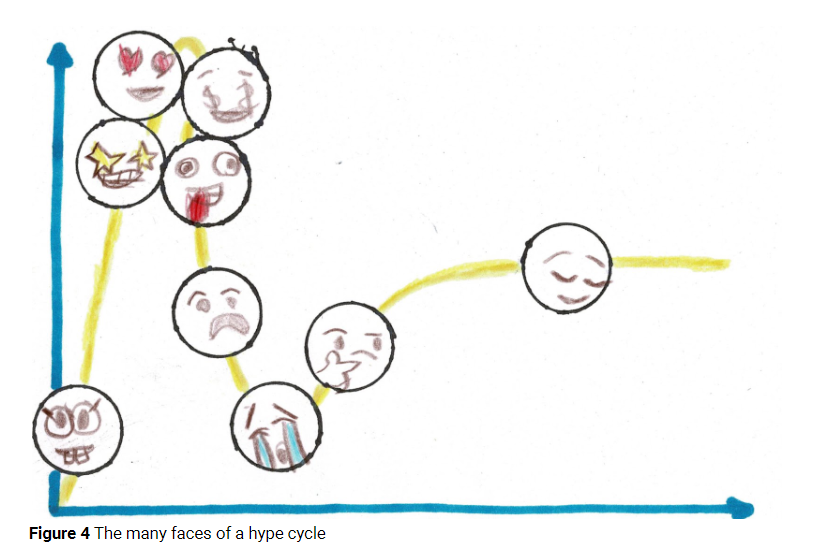
Without actually teaching the lesson, researching the lesson, sharing the results of the lesson …
It’s like the field never gets out of 1st gear, or even neutral.
and I KNOW that research is hard to do. and literature is hard to find. I’m one of those “weird people” that has read a large percentage of all the stuff out there on games and language teaching. in English, and in other languages using translation software. I’ve been trying to find a place where there’s a concerted effort to really make a difference for the field, for students, and to get games and teaching normalized and integrated.
I 100% agree with people who say:
- schools are busy
- directors are busy
- teachers might not have a lot of freedom (James’ playground piece speaks to this)
But what I think that schools/directors/teachers SHOULD know about is a solid teaching framework. Whether it is
- task based language teaching
- Dogme
- project based learning
- soft communicative language teaching (output and fluency)
- hard communicative language teaching (literacy skills)
- literature teaching
- creative writing
- pedagogy of multiliteracies
- test prep
What I struggle to understand with the teaching/practical end of things is:
Why don’t they start with the solid TEACHING foundation and slot a game into that?
In a PPP GBLT lesson, a teacher could:
- present some vocabulary
- practice some vocabulary
- produce some vocabulary (using a communicative language game: 20 questions
👆 I think that something like that is BEAUTIFUL LLP / GBLT
- normalized, integrated. strong pedagogical backbone.
- THAT could be researched and shared (in LLP, in other journals)
I think that starting with the pedagogy and then selecting a game (maybe a conversation game, maybe a short digital game) is ONE strong way to move the field forward, based on the actual context teachers find themselves in (constrained by)
Final Fantasy XVI probably isn’t going to ever be used in a typical teaching context. too long, too technical, etc etc etc.
But teachers/directors CAN start with
- learning outcomes / goals
- strong pedagogy
… and then select games or LUDIC activities (story telling, creative activities, simple role plays to meet those goals. I recognize that I have a lot of freedom where I teach at the university… I really can do ALMOST whatever I want to.
But i’m still constrained by:
- 22 contact hours (and about 20 hours of homework) — that is still a solid cap on how much literacy/project/etc work I can do with students
- 40-50 students in my class
- most students not having gaming laptops etc
and even if I don’t think about my university context, I teach high school students at times, and elementary students sometimes in projects or events, and it’s about the goals and simple frugal games in those cases.
Games like:
- Cockroach Poker (a lying game about bugs)
- Apples to Apples (connecting vocabulary and using comparative and superlative grammar to argue for your choices)
work wonderfully at lower levels that directly connect to specific learning outcomes that can be covered in an hour.
I recently did an interview that got into some “lessons learned” about using various digital games in a classroom environment.
And I think this paper explores digital game based teaching and learning:
TEACHING AND LEARNING ENGLISH THROUGH DIGITAL GAME PROJECTS
deHaan, J. (2011). Teaching and learning English through digital game projects. Digital Culture &
Education, 3:1, 46-55.
in a very specific “it depends” way.
- 15 weeks
- goal of participation using media design (creating an online magazine)
- literacy driven / project based learning driven
I haven’t been exploring digital games recently because:
- tabletop games and classroom games are cheaper
- I have 20 to 40 students in a class
- a lot of non-digital games “do their thing” quicker than a digital game (like 20 questions for yes no grammar practice). though I know that “every day the same dream” and “we become what we behold” are super lean and clean experiences
BUT that is something I’m going to work on in the next 2 years …basically take my https://sites.google.com/site/gamelabshizuoka/gameterakoya PedML work and apply it to digital games in the classroom
James York, Fred Poole and I wrote an article for FLA that includes what we think a progressive Ludic Language Pedagogy research agenda that leapfrogs over the repeated “vaporware” theses and articles might address:
https://onlinelibrary.wiley.com/doi/abs/10.1111/flan.12585 (let me know if you need a copy)
We close by urging teachers and researchers to adopt a ludic attitude in pioneering and developing LLP. Video game bosses are not easily defeated, and pedagogy and ludic tools are not quickly integrated. We should start simply, play more, share more work in progress, share more stories of failure and success, and try and refine ideas in various contexts.
We expect the new inclusive field of LLP to report:
- Extra‐gameplay language activities (e.g., reading and writing online)
- Students not just learning vocabulary, but participating using language
- Teachers’ customized ludic approaches
- Involvement of all students, as failure and persistence are integral to ludic learning
- Research with practical classroom applicability
- Tempered tech‐hype
- Use of simulations, roleplay, drama, debate, pretending, storytelling, and language play
- Connections of academic silos. As Sykes and Reinhardt (2012) connected game studies and Hallidayan linguistics, LLP can connect disciplines, ideologies, cultures, and values. Let’s play with connected learning, digital humanities, learning sciences, social justice, sustainability, entrepreneurship, health, literacy, and studies of protest and disruption (Cook, 2000; Sicart, 2014)
We expect practical reports to playfully
- Chronicle integrations of play and pedagogy
- Explore pedagogies (i.e., materials, mediation, and methods)
- Design and document teacher guidance
- Detail teacher roles before, during, and after gameplay
- Evaluate postgame debriefing
- Connect games with society (i.e., social impact games, participatory transfer)
- Amplify individuals and communities through narratives
- Demonstrate support for students from diverse backgrounds
- Highlight neglected contexts and languages
- Provide models and mentorship to novice teachers.
We expect research to dive deep with
- Ethnographies of various approaches in various contexts
- Spotlights on or comparisons of the Ludic, the Language, the Pedagogy, the playful and the serious
- Stimulated recalls of teachers dynamically scaffolding ludic language learning
- Investigations of teachers’ imagining, integrating, and iterating their ludic pedagogy
- Evaluations of ideologies and values in LLP classrooms
- Showing students transferring language outside the game and the classroom
- Baking praxis (theory, research, and practice) into LLP
- Focusing on teachers’ actions rather than students’ perceptions
- Scholars, journals, and institutions valuing play (i.e., failure and iteration)
- Research‐practice partnerships that solve meaningful problems
Am I totally crazy (well, yes) or wrong about “the field” or how games are ever going to get normalized or integrated or actually researched in a way that raises all boats? 🤔
Please please please let me work with anyone who wants to jump over the first 10 years of think pieces and analyzing games and moving to teaching and sharing teaching with games
I’m happy to share literature from my “Belmont family hold” of literature, papers, notes, etc…
🚁Returning to Mother Base now
Jonathan (My frequency: 215.11.21)
Links:
- https://onlinelibrary.wiley.com/doi/abs/10.1111/flan.12585 – Playing a new game—An argument for a teacher-focused field around games and play in language education by James York, Frederick J. Poole, Jonathan W. deHaan
- https://www.youtube.com/watch?v=mnVVJ6P45yw – JALTCALL 2022 KEYNOTE – Jonathan deHaan – Games and play in (researching) language teaching and learning
- https://www.youtube.com/watch?v=8xiSNGOu4Y8 – Gameful Language Learning – An Interview with Professor Jonathan deHaan (by TESOL Training Pakistan)
- https://llpjournal.org/2020/07/22/dehaan-gblt-vaporware-part-one.html – deHaan, J. (2020). Game-based language teaching is vaporware (Part 1 of 2): Examination of research reports
- https://llpjournal.org/2020/07/22/dehaan-gblt-vaporware-part-two.html – deHaan, J. (2020). Game-based language teaching is vaporware (Part 2 of 2): It’s time to ship or shut down
- https://llpjournal.org/2022/05/11/dehaan-teaching-language-and-literacy-with-games-simplified-for-teachers.html – deHaan, J. (2022). Teaching language and literacy (or anything) with games (or anything): A good way (The pedagogy of multiliteracies) simplified here for teachers and students
Leave a Reply